
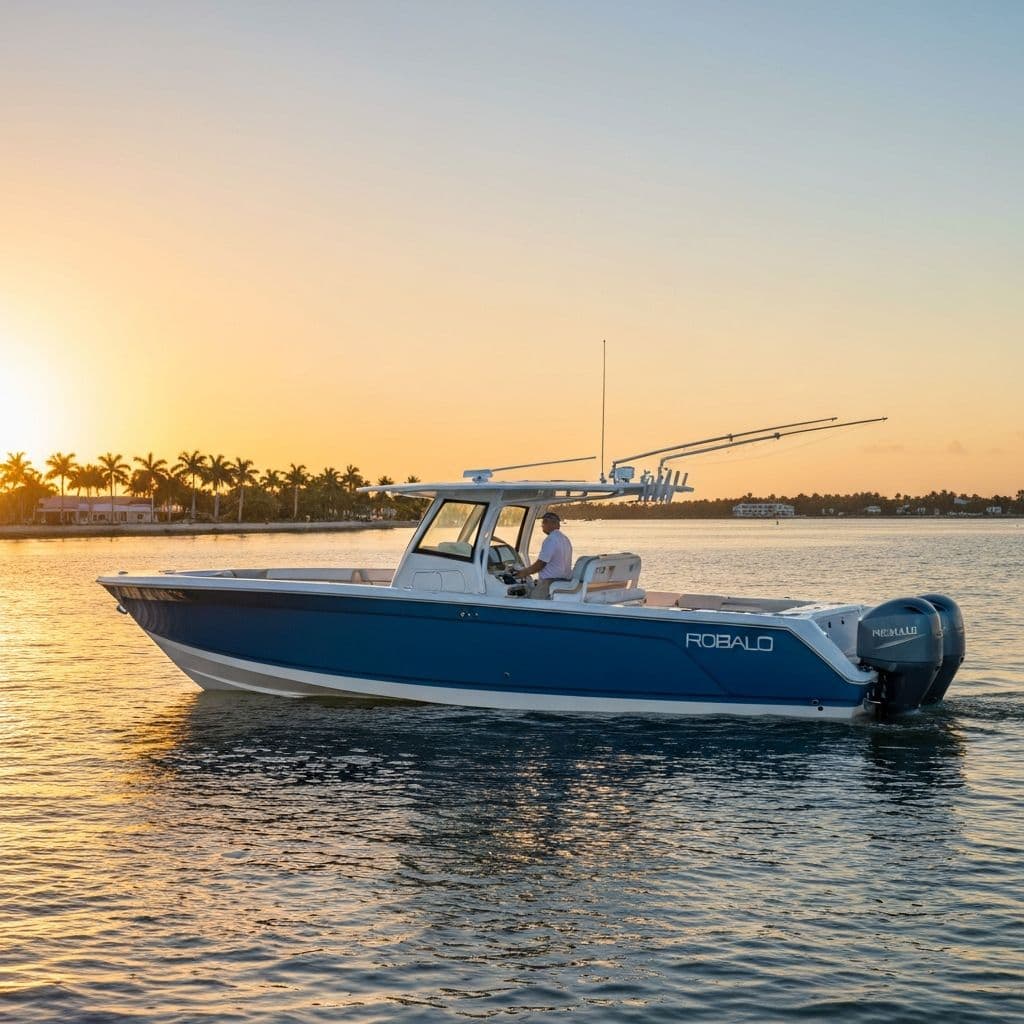
So you have been spending your weekends walking the docks at Fish Tale Boats in Fort Myers, sitting in the helm seat of a Robalo R272, maybe running your hand along the gunwale of a Grady-White Freedom 255. You can already picture yourself idling through the mangroves at Pine Island Sound, the kids spotting dolphins off the bow, a cooler full of drinks, nowhere to be until the sun sets over Cayo Costa.
But then reality taps you on the shoulder: How do I actually pay for this thing?
You are not alone. Most boats are financed, not bought outright. And the good news is that boat financing is more accessible, more flexible, and more straightforward than most people expect. Whether you are a first-time buyer eyeing a Premier Pontoon for sandbar weekends or an experienced angler stepping up to a Grady-White Canyon 306 for serious Gulf fishing, this guide walks you through every piece of the financing puzzle.
We wrote this because we have watched too many buyers stress over the financial side of boat ownership when they did not need to. A little knowledge goes a long way, and by the time you finish reading, you will walk into the dealership with confidence.
Disclaimer: This guide is for general informational purposes only and does not constitute financial advice. Fish Tale Boats is not a financial institution, lender, or licensed financial advisor. Loan terms, interest rates, and eligibility requirements vary by lender and are subject to change. Always consult with your bank, credit union, or a qualified financial professional before making financing decisions. Fish Tale Boats assumes no liability for financial decisions made based on the information in this guide.
How Boat Financing Works
If you have ever financed a car, you already understand the basics. A lender gives you money to buy the boat, you pay them back over time with interest, and the boat itself serves as collateral until the loan is paid off. Simple enough.
But there are some important differences between financing a boat and financing a car.
Longer loan terms. Car loans typically top out at 72 or 84 months. Boat loans can stretch to 240 months (that is 20 years) for larger purchases. This makes sense when you consider that a well-maintained Grady-White holds its value far better than most vehicles and has a useful life measured in decades, not just years.
Marine-specific lenders. While your local bank or credit union can absolutely finance a boat, there is a whole category of lenders that specialize exclusively in marine financing. Companies like LightStream, Essex Credit, and Southeast Financial focus on boat loans and understand the marine market. They often offer competitive rates because they understand boat valuations better than a generalist lender.
Secured vs. unsecured loans. Most boat loans are secured, meaning the boat is the collateral. If you stop making payments, the lender can repossess the vessel. This is actually good for you as a borrower because secured loans carry lower interest rates than unsecured ones. For smaller purchases (generally under $25,000), some lenders offer unsecured personal loans, but you will pay a premium in interest for the convenience.
The documentation is different. Instead of a car title, boats have a registration with the state and potentially documentation with the U.S. Coast Guard for vessels over a certain value. Your lender will file a lien on the vessel registration, similar to how a car lender appears on your vehicle title.
Here is a quick story that illustrates how this typically works. Last spring, a couple came into our Naples location looking at a Chaparral 23 SSI. They had never financed a boat before and assumed they needed 50% down and perfect credit. Turns out they qualified for a 15-year loan with 10% down at a very reasonable rate. Their monthly payment ended up being less than what they were spending on weekend boat rentals. They are now out on the water every Saturday morning, and they own the boat instead of renting one.
What Credit Score Do You Need?
Let us get the most common question out of the way: you do not need perfect credit to finance a boat. You do not even need great credit, though it certainly helps.
Here is the general breakdown:
700 and Above: The Sweet Spot
If your credit score is 700 or higher, you are in excellent shape. You will qualify for the best interest rates, the longest terms, and the most flexible down payment requirements. Most marine lenders consider 700+ to be their "prime" category. A score of 740+ may unlock additional rate discounts.
650 to 700: Solid but Costs More
A score in the 650-700 range still gets you financed with most lenders, but expect rates to be 1-3% higher than what a 720-score buyer sees. You may also need a larger down payment (15-20% instead of 10%) and could face shorter maximum term lengths. Still very workable.
Below 650: Options Exist, But Prepare
Below 650, your options narrow but do not disappear. Some marine lenders and credit unions work with buyers in this range, especially if you have a substantial down payment (20-30%), stable employment, and a low debt-to-income ratio. You may also find success with a co-signer who has stronger credit.
Improving Your Score Before You Apply
If you are not in a rush, spending 3-6 months improving your credit before applying can save you thousands over the life of the loan. Here are the fastest ways to move the needle:
- Pay down credit card balances. Credit utilization (the percentage of your available credit you are using) is one of the biggest factors. Getting below 30% utilization helps. Below 10% is even better.
- Do not open new accounts. Every new credit inquiry dings your score slightly, and new accounts lower your average account age.
- Dispute errors. Pull your reports from all three bureaus. Errors are more common than you would think.
- Become an authorized user. If a family member with excellent credit adds you to one of their long-standing accounts, their history can boost your score.
Down Payments: How Much Do You Need?
The down payment question is one we hear every day at all three of our Southwest Florida locations. And the honest answer is: it depends, but probably less than you think.
The Typical Range: 10% to 20%
Most marine lenders require somewhere between 10% and 20% down. The exact number depends on your credit score, the loan amount, and the lender. On a $60,000 boat, that means $6,000 to $12,000 at signing.
Zero-Down Options
Yes, they exist. Some lenders, particularly for buyers with 720+ credit scores and strong financial profiles, offer financing with no money down. Keep in mind that zero-down means you are financing the entire purchase price, which means higher monthly payments and more total interest paid. It also means you may be "upside down" on the loan for the first few years (owing more than the boat is worth).
Why More Down Is Smarter
Putting more money down is almost always the better financial move, for a few reasons:
- Lower monthly payments. Obvious but important if you are budgeting for insurance, fuel, maintenance, and dockage.
- Less total interest. A larger down payment means a smaller principal balance, which means less interest over the life of the loan.
- Better loan terms. Lenders reward larger down payments with lower rates.
- Equity from day one. You are less likely to owe more than the boat is worth, which matters if you decide to sell or upgrade in a few years.
Trade-In as Down Payment
Already own a boat? Your trade-in value can serve as your down payment, and in Florida, it comes with a tax advantage we will cover in the Florida section below. Fish Tale Boats handles trade-ins regularly. We will give you an honest valuation, and the equity goes directly toward your new purchase. It simplifies the process and reduces your out-of-pocket costs at closing.
Interest Rates and What Affects Them
As of 2026, boat loan interest rates for qualified buyers generally range from about 5.99% to 12% APR, depending on several factors. That is a wide range, so let us break down what determines where you fall on that spectrum.
Credit Score
This is the single biggest factor. A buyer with a 750 credit score might see rates around 5.99-7.50%, while someone at 660 might be quoted 9.00-12.00% for the same boat and loan terms.
Loan Amount
Larger loans often qualify for better rates. Many marine lenders offer their lowest rates on loans of $50,000 or more. A $25,000 loan might carry rates 0.5-1.0% higher than a $75,000 loan, all else being equal.
Boat Age (New vs. Pre-Owned)
New boats generally qualify for the best rates and longest terms. Pre-owned boats may carry slightly higher rates, and the maximum term length often decreases as the boat gets older. A lender might offer 20-year terms on a new boat but cap a 10-year-old boat at 12 years.
Loan Term
Shorter terms typically come with lower rates. A 10-year loan might be priced 0.25-0.75% lower than a 20-year loan. The tradeoff, of course, is higher monthly payments.
Lender Type
Marine-specific lenders, banks, and credit unions all price loans differently. Florida credit unions like Suncoast Credit Union and Eglin Federal Credit Union are currently offering boat loan rates in the 6.75% to 8.00% APR range for well-qualified borrowers, which is competitive with or better than many national marine lenders.
Fixed vs. Variable Rates
Most boat loans are fixed-rate, meaning your payment stays the same for the life of the loan. Variable-rate loans exist but are less common in marine lending. We strongly recommend fixed-rate loans for the predictability they provide.
Loan Terms: Short vs. Long
Boat loan terms range from as short as 36 months to as long as 240 months (20 years). The right term for you depends on the boat price, your budget, and how much total interest you are comfortable paying.
Loans over $50,000 typically qualify for terms of 15 to 20 years. Smaller loans are usually capped at shorter terms.
Real Payment Examples
Let us put real numbers on this using a $75,000 boat with 10% down ($7,500), leaving a $67,500 loan amount at 7.50% APR:
| Term | Monthly Payment | Total Interest Paid | Total Cost |
|---|---|---|---|
| 10 years (120 months) | $800 | $28,539 | $96,039 |
| 15 years (180 months) | $625 | $44,995 | $112,495 |
| 20 years (240 months) | $544 | $63,026 | $130,526 |
Look at that difference. The 20-year loan saves you $256 per month compared to the 10-year, but you pay $34,487 more in total interest. That is the real cost of stretching out your payments.
Now let us look at a $40,000 boat with 15% down ($6,000), leaving a $34,000 loan amount at 7.50% APR:
| Term | Monthly Payment | Total Interest Paid | Total Cost |
|---|---|---|---|
| 7 years (84 months) | $521 | $9,756 | $43,756 |
| 10 years (120 months) | $403 | $14,389 | $48,389 |
| 15 years (180 months) | $315 | $22,668 | $56,668 |
The Sweet Spot for Most Buyers
For most Southwest Florida buyers we work with, the sweet spot tends to be 10 to 15 years on boats in the $50,000-$150,000 range. This keeps the monthly payment manageable while avoiding excessive interest costs. On smaller boats under $40,000, a 7-to-10-year term usually makes the most sense.
One important note: there is no prepayment penalty on most boat loans. So you can take the 15-year term for the lower monthly minimum but make extra payments when you can, effectively shortening the loan without locking yourself into higher required payments.
Here is a real-world example of how that strategy works. A family from Cape Coral financed a Robalo R230 at $62,000 over 15 years. Their required payment was around $575 per month. But during the winter months, when they were spending less on weekend trips and entertainment, they would throw an extra $200-$300 toward the principal. After three years, they were almost a full year ahead of schedule on their payoff. They had the flexibility of a low required payment when money was tight, but they were building equity faster when they could afford to.
A Note on Depreciation and Loan Balance
One thing to keep in mind with longer terms: you want your loan balance to stay roughly in line with the boat's value, especially if you think you might sell or trade in before the loan is paid off. This is where the brands we carry at Fish Tale Boats work in your favor. Grady-White, Robalo, Chaparral, and Premier Pontoons all hold their value better than industry averages, which means you are less likely to end up underwater on a 12 or 15-year loan than you would with a lesser-known brand.
Dealer Financing vs. Bank vs. Credit Union vs. Online Lenders
You have four main paths to boat financing, and each has advantages worth considering.
Dealer Financing
When you buy through Fish Tale Boats and use our financing, we work with a network of marine lenders to find competitive rates on your behalf. Think of it like having someone shop the loan market for you.
Pros:
- One-stop shopping. Handle the boat purchase and financing in the same place.
- Access to multiple lenders. We have relationships with marine lenders that individual borrowers cannot always access directly.
- Promotional rates. Manufacturers occasionally offer special financing through dealer networks.
- Simplified paperwork. We help coordinate everything.
Cons:
- Always good to compare. Even with dealer financing, you should know what your bank or credit union offers so you have a benchmark.
Banks
Your existing bank is a natural starting point, especially if you have a long relationship there.
Pros:
- Existing relationship may help with rate negotiations.
- Familiar process if you have done other loans with them.
Cons:
- Many banks treat boat loans as a niche product and may not offer the most competitive rates.
- Loan officers may not understand marine valuations.
Credit Unions
Florida has some excellent credit unions for boat financing, and they are often among the most competitive options.
Pros:
- Typically lower rates than banks (currently 6.75-8.00% at Florida credit unions like Suncoast and Eglin FCU).
- Member-focused, not profit-driven.
- Often more flexible on credit requirements.
Cons:
- You need to be a member (though joining is usually easy).
- May have lower loan limits than banks or marine lenders.
- Fewer may have marine-specific expertise.
Online Marine Lenders
Companies like LightStream, Essex Credit, and Southeast Financial specialize in boat financing and operate entirely online.
Pros:
- Quick approvals, often same-day.
- Competitive rates, especially for higher credit scores and larger loan amounts.
- Deep marine expertise.
Cons:
- No in-person relationship.
- Terms and conditions vary widely between lenders.
Our Recommendation
Get pre-approved through at least two sources before you start shopping. This gives you a baseline rate to compare against whatever dealer financing offers. At Fish Tale Boats, we are genuinely trying to get you the best deal. If you bring in a pre-approval from your credit union at 6.75% and we can match or beat it through our lender network, great. If we cannot, we will tell you to go with your credit union. Putting you in the right financing is just as important to us as putting you on the right boat.
A retired couple from Bonita Springs shared a story with us that makes this point perfectly. They had been pre-approved through their bank at 8.25%. When they came in to buy a Premier 250 Grand Entertainer pontoon, our finance team submitted their application to three marine lenders. One came back at 7.10%. That difference of just over one percent saved them roughly $4,800 over the life of the loan. They had no idea that was possible until they let us shop it for them. The lesson: never assume the first rate you see is the best one available.
Financing in Florida: Tax Advantages You Should Know
Here is where living in Florida, and specifically buying your boat in Florida, gets interesting. The Sunshine State has some genuinely favorable rules for boat buyers.
The $18,000 Sales Tax Cap on Vessels
This is the big one that surprises almost every out-of-state buyer who walks into our Bonita Springs location.
Florida charges a 6% state sales tax on vessel purchases, but caps the state portion at $18,000. That means once you hit $300,000 in purchase price, you stop accumulating state sales tax. Whether you buy a $300,000 boat or a $600,000 boat, the state sales tax is the same $18,000.
On top of the state tax, there is a county discretionary surtax:
- Lee County (Fort Myers, Bonita Springs, Cape Coral): 0.5% surtax, capped at the first $5,000 of the purchase price (max $25 surtax)
- Collier County (Naples, Marco Island): 1.0% surtax, capped at the first $5,000 of the purchase price (max $50 surtax)
So on a $100,000 boat purchased in Lee County, your total sales tax would be approximately $6,025 (6% state = $6,000 + 0.5% county on first $5K = $25). On a $400,000 boat, it would be $18,025. The savings at higher price points are enormous compared to states without a cap.
For the most current tax rates and rules, check the Florida Department of Revenue website.
Trade-In Tax Savings
When you trade in your current boat toward the purchase of a new one, Florida taxes only the difference between the new boat price and the trade-in value. So if you are buying a $120,000 boat and trading in your current boat at $40,000, you pay sales tax on $80,000, not $120,000. That saves you roughly $2,400 in tax. Another reason to consider trading in your current boat at Fish Tale Boats.
No State Income Tax
This is not boat-specific, but it matters. Florida has no state income tax, which means more of your income stays in your pocket for things like, well, boats. If you are relocating from a high-tax state, the income tax savings alone can cover a meaningful chunk of a boat payment.
Non-Resident Exemption
If you are a non-resident buying a boat in Florida and plan to take it out of state within a specific timeframe, you may qualify for a sales tax exemption. The rules are particular about documentation and timing, so consult with your financial advisor or the Florida Department of Revenue for specifics.
Vessel Registration Costs
Florida requires all boats with motors to be registered with the Florida Highway Safety and Motor Vehicles (FLHSMV). Registration fees are based on vessel length and are renewed annually:
| Vessel Length | Annual Registration Fee |
|---|---|
| Under 12 feet | $5.50 |
| 12 to under 16 feet | $16.25 |
| 16 to under 26 feet | $27.00 |
| 26 to under 40 feet | $78.00 |
| 40 to under 65 feet | $114.00 |
| 65 to under 110 feet | $152.00 |
| 110 feet and over | $189.75 |
These fees are modest compared to many other states and are part of the reason Florida is one of the most boat-friendly states in the country.
Year-Round Boating Justifies the Investment
Here is something that buyers relocating from northern states sometimes overlook when they are running the numbers on boat ownership. In Michigan or Minnesota, your boat sits on a trailer or in winter storage for five to six months of the year. In Southwest Florida, you can be on the water 12 months a year. When you divide your total annual cost of ownership by the number of days you actually use the boat, the per-trip cost in SWFL is dramatically lower than anywhere with a real winter. A boat that costs $700 per month to own is a different value proposition when you use it 40 weekends a year versus 20. That is not a reason to buy more boat than you can afford, but it is worth factoring in when you are evaluating whether a boat payment makes sense for your lifestyle.
The Pre-Approval Process
If there is one piece of advice we could give every boat buyer, it is this: get pre-approved before you start seriously shopping.
What Pre-Approval Is
Pre-approval means a lender has reviewed your financial information, pulled your credit, and told you exactly how much they are willing to lend and at what rate. It is not a commitment to borrow. It is a commitment from the lender that the money is available if you want it.
Why It Matters
You know your budget. No more guessing whether you can afford the 272 or need to look at the 246. You know your ceiling, and you can shop with confidence.
You negotiate from strength. Sellers and dealers take pre-approved buyers more seriously. It signals that you are ready to move, not just browsing.
You can compare rates. With a pre-approval letter in hand, you have a concrete number to compare against other offers.
It speeds up closing. When you find the right boat, you do not have to wait for financing. The money is already lined up.
How It Works at Fish Tale Boats
Our pre-approval process is simple and low-pressure. You fill out a short application, we submit it to our lender network, and you typically hear back within 24-48 hours. There is no obligation, no cost, and no commitment. If the rates work for you, great. If not, no hard feelings.
We had a customer last year who got pre-approved through our site on a Monday, came in Tuesday to look at a Robalo 246 Cayman he had been watching, and had the paperwork done by Thursday. He was fishing the flats off Sanibel that weekend. Pre-approval made that possible.
What Lenders Look At Beyond Credit Score
Your credit score opens the door, but lenders look at the whole picture before deciding on your loan terms.
Debt-to-Income Ratio (DTI)
This is the percentage of your gross monthly income that goes toward debt payments. Most marine lenders want to see a DTI below 40-45%, including the proposed boat payment. If you earn $8,000 per month and currently pay $2,000 in debts (mortgage, car, credit cards), your DTI is 25%. Adding a $600 boat payment brings it to 32.5%, which is comfortable for most lenders.
Employment and Income History
Lenders like stability. Two or more years at the same employer (or in the same industry, if you have changed jobs) is ideal. Self-employed borrowers can qualify but typically need to provide two years of tax returns.
Liquid Assets
Having cash reserves beyond your down payment reassures lenders. If you are putting 10% down and have another 10-15% sitting in savings, that is a strong application.
The Boat Itself as Collateral
Lenders care about what they are lending against. A current-model-year Grady-White or Robalo from an authorized dealer is a low-risk asset. These brands hold their value well, which makes lenders more comfortable with favorable terms. Older boats, unusual brands, or private-party sales may receive more scrutiny.
Marine Survey (for Pre-Owned Boats)
If you are financing a pre-owned boat, most lenders require a marine survey once the loan exceeds a certain dollar amount (often $25,000-$30,000). A marine survey is a professional inspection of the hull, systems, engine, and overall condition. Think of it as a home inspection for boats. The survey protects both you and the lender by confirming the boat is worth what you are paying.
Common Financing Mistakes to Avoid
After working with thousands of boat buyers over nearly three decades, we have seen the same mistakes come up again and again. Here is how to avoid them.
Mistake 1: Only Looking at the Monthly Payment
"I can afford $500 a month" is a starting point, not a strategy. A $500 payment over 10 years costs you a very different amount than $500 over 20 years. Always look at the total cost of the loan, not just the monthly number.
Mistake 2: Not Shopping Rates
The difference between 6.5% and 8.5% on a $70,000 loan over 15 years is roughly $10,000 in total interest. That is worth a few phone calls and applications. Get at least two or three quotes.
Mistake 3: Skipping Pre-Approval
Walking into a dealership without knowing your budget is like going grocery shopping when you are starving, with no list. You are more likely to overspend, get surprised by terms, or lose out on a boat while waiting for financing to come through.
Mistake 4: Ignoring Total Ownership Costs
The loan payment is just the beginning. Budget for:
- Insurance: $500-$2,000+ per year depending on boat size and value
- Fuel: Varies widely, but a typical center console burning 15-20 gallons per hour at cruise adds up
- Maintenance: Budget 1-2% of the boat's value annually for routine maintenance
- Storage or dockage: $150-$500+ per month for wet slip or dry storage in Southwest Florida
- Winterization: Not a concern here in SWFL, which is one of the perks of year-round boating
A guy came in two summers ago, pre-approved for a $90,000 loan. After we walked through the real ownership costs together, he decided a $65,000 boat was the smarter play. He is glad he did. He tells us every time he comes in for service that he loves his boat and never stresses about the payment.
Mistake 5: Financing for Too Long
Just because you can get a 20-year loan does not mean you should. If you plan to upgrade in 5-7 years (which is common), you want to have built enough equity to trade in comfortably. Stretching the loan too long can leave you upside down when it is time to move up.
Mistake 6: Not Reading the Fine Print
Look for origination fees, prepayment penalties (rare but they exist), and late payment terms. A loan with a slightly higher rate but no fees might cost less overall than a "low rate" loan with $1,500 in origination charges.
Frequently Asked Questions
Can I finance a used boat?
Absolutely. Most lenders finance pre-owned boats, though terms (rates, maximum loan length, down payment requirements) may differ from new boat financing. The boat's age, condition, and brand all factor in. Well-known brands like Grady-White and Robalo tend to get better financing terms on the pre-owned market because of their strong resale values. Check out our pre-owned inventory to see what is currently available.
Is boat loan interest tax deductible?
It can be, under certain conditions. If your boat has a berth (sleeping area), a galley (kitchen), and a head (bathroom), the IRS may consider it a "second home," making the loan interest potentially deductible on your federal taxes. This applies to many boats 25 feet and over, including several models in the Grady-White and Chaparral lineups. However, tax law is complicated, and this deduction depends on your individual tax situation. Consult a tax professional for advice specific to your circumstances.
Can I refinance my boat loan?
Yes. If rates have dropped since you originally financed, or if your credit score has improved significantly, refinancing can lower your monthly payment or total interest cost. The process is similar to refinancing a car or mortgage. Most lenders will refinance boat loans with a remaining balance of $25,000 or more.
What if I have bad credit?
Options include: a larger down payment (20-30%), a co-signer with stronger credit, credit unions that specialize in working with lower scores, or taking 6-12 months to improve your credit before applying. Some lenders also offer "subprime" marine loans, though rates will be higher (10-15%+).
How long does the approval process take?
For a well-prepared buyer with all documents ready, pre-approval can happen in 24-48 hours. Final approval after selecting a specific boat typically takes 3-5 business days. At Fish Tale Boats, our finance team works to keep the process moving so you are not waiting longer than necessary.
What documents do I need to apply?
Most lenders require:
- Government-issued ID
- Proof of income (recent pay stubs or tax returns for self-employed applicants)
- Proof of residence
- Bank statements (typically last 2-3 months)
- Details of the boat you want to purchase (or general price range for pre-approval)
Can I finance a boat with a trade-in?
Yes, and it is a popular option. Your trade-in equity counts toward the down payment, and in Florida you get the tax savings on the price difference. Visit our trade-in valuation page to get an estimate of your current boat's value.
Do I need a marine survey?
For new boats from an authorized dealer, no. For pre-owned boats, lenders typically require a survey on loans above $25,000-$30,000. Even when not required, we recommend a survey on any pre-owned purchase. It is one of the smartest investments you can make as a buyer.
Can I include accessories and upgrades in the loan?
In most cases, yes. Electronics packages, outriggers, T-tops, trailer upgrades, and other factory or dealer-installed accessories can usually be rolled into the boat loan. Aftermarket accessories added later would need separate financing.
What happens if I miss a payment?
Contact your lender immediately. Most lenders have grace periods (typically 10-15 days) and would rather work with you than repossess a boat. Communication is key. If you are facing a temporary financial hardship, many lenders offer forbearance or modified payment plans.
Ready to Get Started?
The best time to start the financing process is before you fall in love with a specific boat. Get your credit in order, understand your budget, and get pre-approved so you know exactly what you are working with.
When you are ready, come see us at any of our three Southwest Florida locations:
- Fort Myers (headquarters, full-service center)
- Naples
- Bonita Springs
Our team has been helping Southwest Florida families get on the water since 1996. We will walk you through the financing process, answer every question you have, and make sure you end up on the right boat at the right payment. No pressure, no games, just honest advice from people who love boats as much as you do.
Start your pre-approval today | Browse new boats | Explore pre-owned inventory | Get your trade-in value | Contact us
Related Guides:
- Boat Loan Calculator - Run your own payment scenarios
- How to Choose Your First Boat - Match the right boat to your lifestyle
- Discover Boating: Financing Basics - Industry resource for new buyers